Recently, my wife and I spent the weekend in Miami for Unrivaled (women’s 3×3) basketball. I was so excited to get on a plane in zero-degree Iowa and deplane in sunny Florida. Could I leave my puffer coat in the car? Will I be able to swim? I laid out my shorts and seersucker, fantasizing about Florida Nick (think The Office’s Florida Stanley).
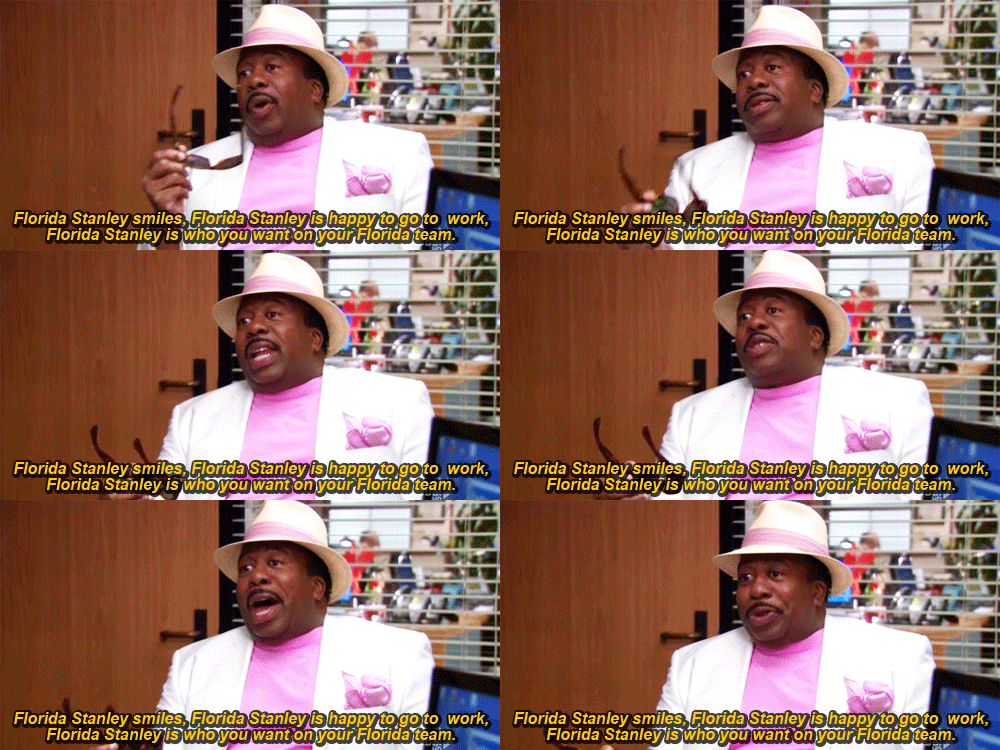
You know where this is going. An arctic blast hit the southeast that very weekend. No shorts. Closed pool. I wore that damn puffer coat the whole time.
Luckily, we had some great basketball to watch. Caitlin Clark’s meteoric rise turned us into big fans of the W and the scrappy off-season startup, Unrivaled. Started by Napheesa Collier and Breanna Stewart, the league is truly by players, for players, giving them a way to play and make money at home in a (theoretically) warm state instead of going overseas.
Courtside and Personal
Consisting of eight teams, the rosters are small. The court is shorter and narrower. The game itself is fast and fun, as we’d seen on TV. But it was even more so in person.
Sephora Arena holds about 1,000 people, but feels smaller. You’re close enough to high-five Rickea Jackson (I did) and see stars like Paige Bueckers up close. But the best part? You can hear them.
Sitting near the tunnel to the locker room, we heard Monique Billings—frustrated that her team was down at halftime—roar with frustration. When a pass didn’t go where she intended, I heard Kelsey Mitchell snap, “C’mon, Kels!” To herself.
And that got me thinking …
The Storyteller in Your Head
The stories we tell ourselves are powerful. While negative self-talk can be paralyzing, athletes know the secret: you have to be your own coach. It’s great to have friends in the stands, but you should cheer for yourself, too. Literally—in the second or even third person.
The Little Engine That Could famously chugged along, saying, “I think I can.” Cute story, but it’s not as productive as saying to yourself while running up a particularly challenging hill, “You got this,” or better still, “You’re doing great, Nick.” (Yes, I do this on my runs.) Research from Ethan Kross shows that this “distanced self-talk” works because your brain codes it as external support. It’s a scrappy way to bypass your inner critic and give yourself the same encouragement you’d give a friend.
When I first went out on my own, I remember laughing uncomfortably at the adage that an entrepreneur trades one external boss for an even more demanding one. As Homer Simpson says, “It’s funny because it’s true.” We could all probably stand to be a bit nicer to ourselves.
In addition to watching Unrivaled, I’ve also been recording episodes for the latest season of the podcast I host for the University of Iowa’s Tippie College of Business. The theme: Being the CEO of your life. I can’t wait to share these expert insights on personal and professional development. But as you think about new directions and self-leadership, incorporate a bit of positive self-talk. Again, the stories we tell ourselves are powerful. Make sure it’s a good one.
Story Strategy: 3-Word Self-Leadership Hack
The most important story you tell is the one you tell yourself.
Apply it: The next time you face a “free-throw line” moment—a high-stakes presentation, a difficult conversation, or a grueling workout—try this 3-word trick. Instead of thinking “I can do this,” use three words plus your name: “You’ve got this, Nick.”
 A version of this first appeared in Story Strategies—my monthly email newsletter designed to help you connect with your audience through the power of story. Get the next issue delivered to your inbox.

